
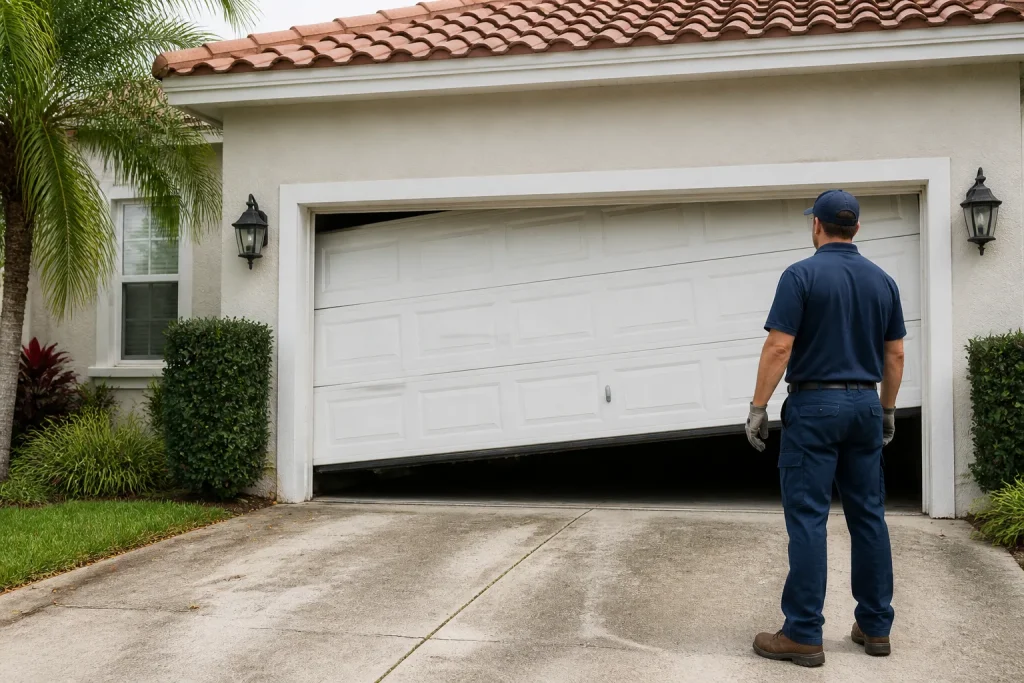
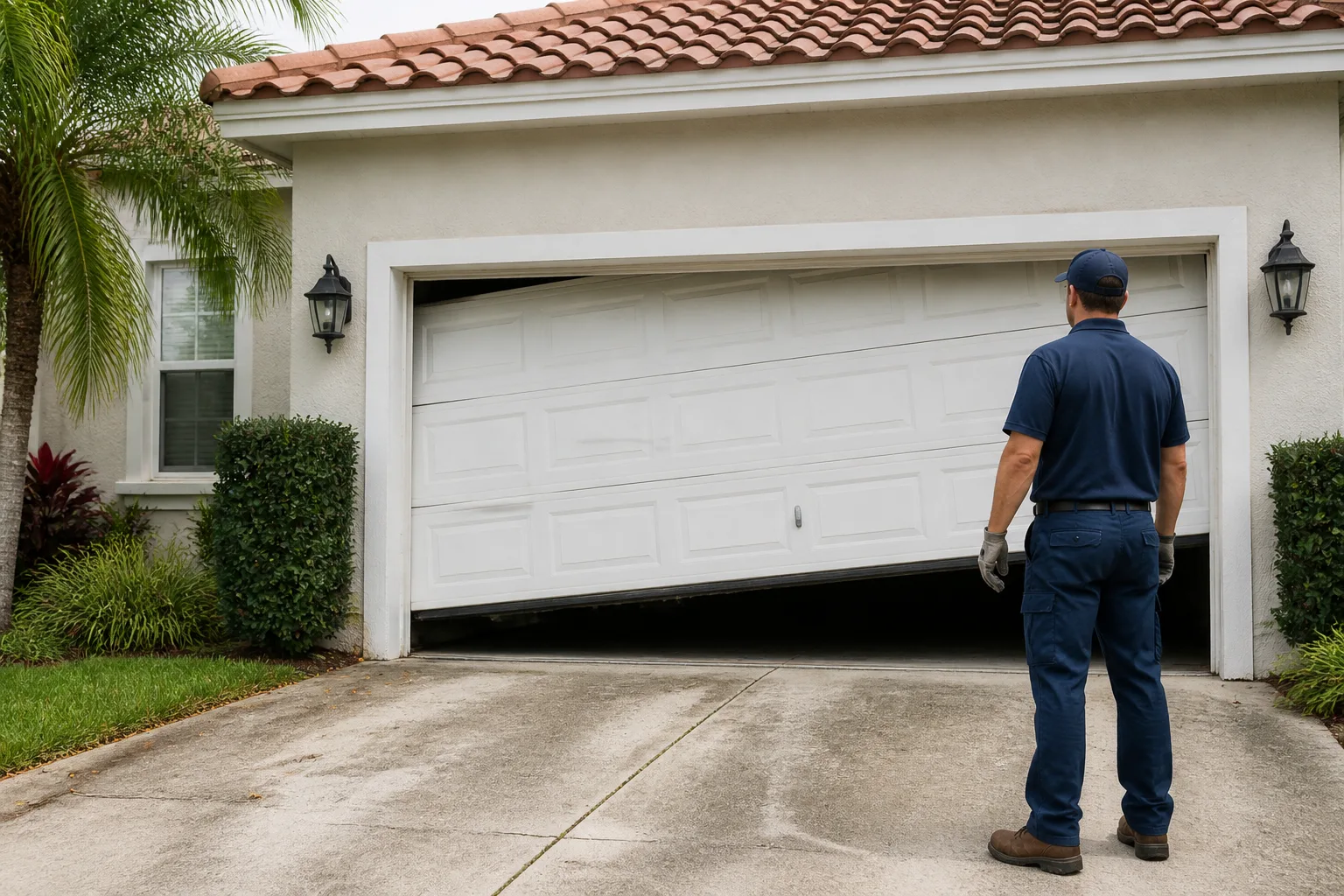
Top Signs You Need Garage Door Service – Don’t Ignore These
The most common mistake we see is homeowners waiting until the door stops working entirely. A garage door rarely fails without warning. It grinds, pops, slows down, or bounces at the floor for weeks first. Those symptoms are diagnostic data: each sound and movement points to a specific part wearing out. Here are the signs that matter in Port Saint Lucie, and what each one tells you about what’s about to break. If a test below feels beyond a quick look, call (855) 337-1068.
Which sounds mean which parts?
Sound is the most reliable early warning you’ve got, because each failing component produces a distinct noise. Listen with the door closed and quiet around you for one full open-and-close cycle. The pitch and rhythm tell a technician most of what they need before the door is even touched.
- Grinding: Usually worn nylon rollers or a bearing losing lubricant. Grinding is a maintenance signal more than an emergency, but it adds strain to the opener every cycle.
- Popping or a single loud snap: Often a slipping cable on the drum or a track fastener giving way. Popping can release tension suddenly, so it moves to the top of the list. Stop using the door until it’s looked at.
- Rattling: Loose hinges, brackets, or bolts vibrating with the panel movement. Often the easiest fix on this list, but ignored rattling loosens hardware further.
- Squealing: Dry hinges and rollers asking for lubrication. A squealing door isn’t dangerous yet, but a dry roller is a grinding roller waiting to happen.
One rule holds for all four: any noise paired with the door jerking or reversing belongs in the stop-and-call category. Springs and cables are under extreme tension, and the cause of a pop or snap is never something to investigate with your hands. We work on garage door repair every day, and a noisy door is the easiest thing to catch before it strands your car.
How do you do the sixty-second balance test?
The balance test tells you whether your springs are carrying their share of the door’s weight. It takes about a minute and needs no tools.
- Close the door and disconnect the opener using the release cord, usually a red handle hanging from the rail.
- Lift the door by hand to roughly waist height, halfway open.
- Let go and watch. A healthy door stays put, nearly weightless in your hands.
- If it drops, sags, or feels heavy to lift, the springs have lost tension or one has failed.
What the result means: a balanced door puts no extra load on your opener motor. An unbalanced one forces the motor to drag dead weight with every cycle, which is the single most common way openers burn out early on a LiftMaster or Chamberlain unit. The test is safe to repeat since you’re only lifting, but don’t go further. Adjusting or replacing springs yourself is genuinely dangerous work. That’s a job for a technician, full stop.
Why does my door slow down in Port Saint Lucie summers?
A door that runs fine in cooler months but drags or slows in the Port Saint Lucie heat is usually fighting its own track. Metal expands as temperatures climb, and a track that’s slightly out of alignment in mild weather can pinch the rollers once it heats up. The opener then works harder to push through the friction, and you notice it as a slow, strained door.
We see this pattern often in garages that face the afternoon sun. It’s tempting to blame the opener and start shopping for a new one, but a sluggish, heat-linked door is usually a track and roller issue. What to check without tools: look down the track edges for a kink or a spot where the rollers look pinched. If you find one, leave it and call. Realigning a track is a quick professional fix, and getting ahead of it means your opener isn’t quietly wearing itself out all summer.
If the slow cycle comes with a hum from the opener motor or the door stalling partway, that’s a different conversation. That’s where garage door opener repair comes in rather than track work.
What do rust and corrosion on springs and cables tell you?
In Port Saint Lucie, humidity is part of daily life, and it works on steel every day. Springs and cables are the parts most affected, and rust is a surprisingly readable clock. Light surface rust across a spring’s coils means maintenance territory: lubrication helps and there’s life left. Rust concentrated in one area, flaking steel, or visible pitting on the coils is different. That spring is losing strength unevenly, and it’s the spot where a break will start.
- Months of life left: even, light surface dusting of rust with no flaking.
- Weeks, not months: rust concentrated in one arc of the spring, or cables with visible fraying or a fuzzy look.
- Stop using the door: a cable with broken strands standing out, or any visible gap in the coil.
Cables deserve the most respect on that list. A frayed cable is a cable that’s already partly failed, and the door’s tension is riding on the remaining strands. Don’t spray anything on it and don’t touch it. Call for spring and cable inspection. From the spring on a Clopay door to a Genie opener straining against one, we’ve seen every version of this pattern.
What if the door reverses before it touches the floor?
A door that reverses an inch off the ground is often misdiagnosed as a sensor problem. In our experience, roughly four in ten of these are close-force adjustments on the opener itself, not the safety sensors. The opener has a force setting that tells it how much resistance to accept before reversing. When that setting drifts too low, or the door is dragging slightly, the opener reads normal friction as an obstacle and bounces right back up.
Quick sensor check first, since it’s easy: make sure nothing blocks the beam at the floor and the sensor lights are steady, not flickering. If the lights are fine and the door still reverses at the same spot, the likely culprit is the close-force setting or a small obstruction in the door’s path. Force limits exist to protect people and pets, so they shouldn’t be adjusted by guesswork. A technician sets them by the book, which is exactly the kind of thing we handle on Chamberlain and Genie systems regularly. Call (855) 337-1068 for a free estimate if your door keeps bouncing.
When should you call a pro?
Call a trained professional the moment a symptom involves springs, cables, or an opener that won’t respond. Those parts carry stored energy or line voltage, and the risk isn’t worth a DIY attempt. A door that binds is one dropped panel away from a real problem. A noisy door or a slow cycle is fine to watch for a short while, but don’t let it run for months.
Our technicians have up to 13 years of experience and can match the right parts to the system you actually own, whether that’s a LiftMaster opener or a Wayne Dalton door. Free estimates, upfront pricing, and the price is quoted and agreed before any work starts. For full replacements, we offer a free measure and a written price. For a door that’s worn out entirely, garage door installation covers a fresh start.
The Bottom Line
Your door is telling you what it needs, if you know what to listen for. Grinding means rollers, popping means cables or drums, rattling means loose hardware, and squealing means dry hinges. Run the sixty-second balance test, watch for heat-driven drag, and read the rust on your springs like a gauge. The slow-down in summer and the bounce before the floor are often simple fixes caught early. If you’re in Port Saint Lucie and need help, Port Saint Lucie Garage Door Repair offers free estimates. Call (855) 337-1068. We answer 24/7, with fast dispatch from 7am to 7pm, Sunday through Friday.
Frequently Asked Questions
Not long, especially with a grinding or popping noise. Squealing and rattling are maintenance calls that can wait days, but grinding wears your opener motor and popping can lead to sudden cable failure. Book a free estimate and get it checked before it becomes an urgent repair.
Often, yes. Heat-expanded track issues and minor roller problems are frequently resolved on the first visit when parts are on hand. Call (855) 337-1068 for an exact quote. Estimates are free, and the price is set before work begins.
The test itself is safe since you’re lifting the door by hand and watching. What’s not safe is adjusting or replacing springs based on the result. Leave that to a trained technician who works on springs and cables daily.
No. We quote and agree the price before any work starts, so you know the number up front. Call (855) 337-1068 for a free estimate on your door.
Written by the team at Port Saint Lucie Garage Door Repair.
Need Garage Door Help?
Call Port Saint Lucie Garage Door Repair - the local pro we connect you with is licensed and insured, here with fast help in Port Saint Lucie.
(855) 337-1068